
Proven 4K IPTV streaming Guide 2026

4K IPTV streaming has revolutionized how we consume entertainment, offering unparalleled visual fidelity and a vast array of content. In 2026, the landscape of 4K IPTV streaming continues to evolve, bringing even more sophisticated features, seamless integration, and an ever-expanding library of ultra-high-definition programming. If you’re looking to elevate your viewing experience, understanding the nuances of 4K IPTV streaming is essential. This comprehensive guide will equip you with the knowledge needed to dive into the world of crystal-clear entertainment.
Table of ContentsUnderstanding 4K IPTV Streaming: What’s New in 2026?Choosing the Best 4K IPTV Streaming ProviderOptimizing Your Setup for Seamless 4K IPTV StreamingEnhancing Your 4K IPTV Streaming Experience with the Right DevicesTroubleshooting Common Issues with 4K IPTV StreamingThe Future of 4K IPTV Streaming: Trends to Watch in 2026 and BeyondFAQs about 4K IPTV StreamingRelated IPTV Services
Understanding 4K IPTV Streaming: What’s New in 2026?
4K IPTV streaming, often referred to as Ultra HD IPTV, delivers content with a resolution of 3840 x 2160 pixels, which is four times the resolution of standard Full HD (1080p). This significant leap in pixel count translates to incredibly sharp images, finer details, and a more immersive viewing experience. In 2026, advancements in compression technologies like AV1 and VVC (Versatile Video Coding) are making 4K IPTV streaming even more efficient, reducing bandwidth requirements without compromising quality. This means smoother playback and less buffering, even for users with moderate internet speeds.
Beyond resolution, 4K IPTV streaming in 2026 often incorporates High Dynamic Range (HDR) technology. HDR expands the range of colors and contrast, making bright areas brighter and dark areas deeper, resulting in a more lifelike and vibrant picture. When combined with the increased pixel density of 4K, HDR creates a truly stunning visual feast. Many providers now offer a wide selection of HDR-enabled content, from blockbuster movies to live sports, ensuring you get the most out of your 4K display.
Another key development is the proliferation of smart features and AI integration within 4K IPTV streaming platforms. Voice commands are becoming more sophisticated, allowing users to navigate content, search for specific programs, and even control other smart home devices with greater ease. Personalized recommendations, powered by advanced algorithms, are also more accurate than ever, helping you discover new content tailored to your tastes. The overall user experience for 4K IPTV streaming is becoming increasingly intuitive and personalized.
Furthermore, cloud-based DVR services are now standard for many 4K IPTV streaming providers. This allows you to record your favorite shows and movies in 4K quality and access them from any compatible device, without the need for local storage. This flexibility is a significant advantage for those who want to watch content on their own schedule. The convenience and quality offered by modern 4K IPTV streaming services are truly remarkable.
Choosing the Best 4K IPTV Streaming Provider
Selecting the right 4K IPTV streaming provider is crucial for a satisfying experience. With numerous options available, it’s important to consider several factors. First and foremost, assess the content library. Does the provider offer a wide range of 4K content, including movies, TV shows, sports, and documentaries? Look for providers that regularly update their content and offer a diverse selection to cater to different interests. You can check out iptvput.com/channels to see the vast array of channels available with a premium IPTV service.
Next, evaluate the streaming quality and reliability. A good 4K IPTV streaming service should offer consistent 4K resolution with minimal buffering. Look for providers that utilize robust servers and have a proven track record of stable performance. Many providers offer free trials, which can be an excellent way to test their service before committing to a subscription. Pay attention to the picture quality, sound, and overall responsiveness of the platform during your trial.
Customer support is another vital aspect. In case you encounter any technical issues or have questions, responsive and knowledgeable customer support can make a huge difference. Check reviews and testimonials to gauge the provider’s reputation for customer service. A provider that offers 24/7 support via multiple channels (live chat, email, phone) is generally a good sign of their commitment to user satisfaction. The quality of your 4K IPTV streaming experience can hinge on these details.
Finally, consider the pricing and subscription plans. While some providers offer incredibly low prices, it’s often a trade-off for quality or reliability. Balance cost with the features and service quality. Look for transparent pricing with no hidden fees. Many providers offer various subscription tiers, allowing you to choose a plan that fits your budget and viewing habits. You can explore different pricing options at iptvput.com/pricing to find a plan that suits your needs for 4K IPTV streaming.
Optimizing Your Setup for Seamless 4K IPTV Streaming
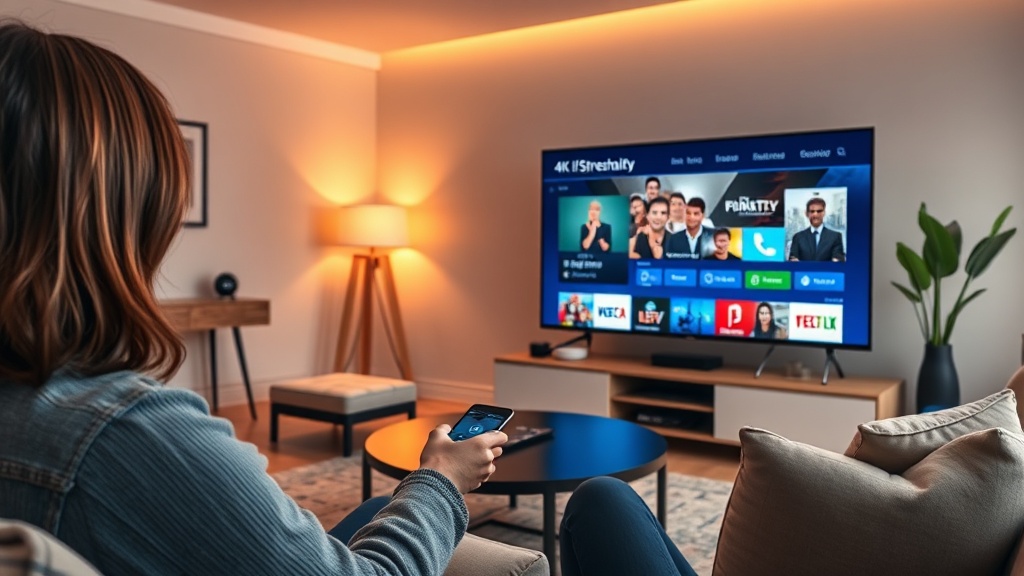
To fully enjoy 4K IPTV streaming, your home setup plays a critical role. The foundation of a great 4K experience is a fast and stable internet connection. For reliable 4K streaming, a minimum download speed of 25 Mbps is generally recommended, but 50 Mbps or higher is ideal, especially if multiple devices are using the network simultaneously. Consider upgrading your internet plan if you frequently experience buffering or drops in quality during 4K IPTV streaming.
Your display device is equally important. To see true 4K quality, you’ll need a 4K compatible TV or monitor. Ensure your display supports HDR if you want to take advantage of enhanced color and contrast. Connect your streaming device to your TV using a high-speed HDMI cable (HDMI 2.0 or newer) to ensure proper transmission of 4K and HDR signals. Older HDMI cables may not be able to handle the increased bandwidth required for 4K IPTV streaming.
The streaming device itself also matters. While many smart TVs have built-in IPTV apps, a dedicated 4K streaming box or stick often provides better performance, more features, and a wider range of app support. Devices like the NVIDIA Shield TV, Amazon Fire TV Cube, Apple TV 4K, and various Android TV boxes are excellent choices for 4K IPTV streaming. These devices typically have powerful processors and ample RAM to handle demanding 4K content smoothly.
For the best audio experience, consider a soundbar or home theater system. While 4K focuses on visuals, immersive audio can greatly enhance your overall entertainment. Many 4K IPTV streaming services support advanced audio formats like Dolby Atmos and DTS:X, which can be truly transformative when paired with compatible audio equipment. Don’t underestimate the impact of good sound on your 4K IPTV streaming enjoyment.
Enhancing Your 4K IPTV Streaming Experience with the Right Devices
The device you use for 4K IPTV streaming can significantly impact the quality and fluidity of your viewing experience. As mentioned, dedicated streaming boxes or sticks often outperform built-in smart TV apps. When choosing a device, look for strong processing power and sufficient RAM to handle the demands of 4K video decoding and multitasking. Devices with quad-core or octa-core processors and at least 2GB of RAM are usually a good starting point for smooth 4K IPTV streaming.
Operating system compatibility is another factor. Android TV devices offer great flexibility, allowing you to install a wide range of IPTV applications and customize your setup. Apple TV 4K provides a polished user interface and excellent integration with the Apple ecosystem. Amazon Fire TV devices are popular for their ease of use and integration with Alexa. Consider which ecosystem best suits your preferences and existing devices. For more information on compatible devices, visit iptvput.com/devices.
Connectivity options are also important. While Wi-Fi is convenient, an Ethernet connection is always recommended for the most stable and reliable 4K IPTV streaming. A wired connection minimizes interference and ensures consistent bandwidth, reducing the likelihood of buffering or dropped frames. If a wired connection isn’t feasible, ensure your Wi-Fi router supports Wi-Fi 5 (802.11ac) or Wi-Fi 6 (802.11ax) and is placed optimally for strong signal strength.
Remote control functionality and user interface design also contribute to the overall experience. A remote with voice control capabilities can make navigation much easier, especially when searching for specific content. A well-designed, intuitive user interface will allow you to quickly find and launch your favorite 4K IPTV streaming channels and apps without frustration. Spend some time researching device reviews to find one that offers the best combination of performance, features, and usability for 4K IPTV streaming.
Troubleshooting Common Issues with 4K IPTV Streaming
Even with the best setup, you might occasionally encounter issues with 4K IPTV streaming. One of the most common problems is buffering. This is usually caused by an insufficient internet connection speed or network congestion. First, try restarting your router and modem. If the problem persists, check your internet speed using an online speed test. If your speed is below the recommended minimum for 4K streaming, consider upgrading your internet plan or reducing the number of devices using your network simultaneously. Using an Ethernet cable instead of Wi-Fi can also significantly reduce buffering for 4K IPTV streaming.
Another frequent issue is poor picture quality or pixelation. This can sometimes be due to the source content itself, but more often, it’s related to your internet speed or the quality settings within your IPTV app. Ensure your app is set to stream in 4K resolution if available. If your internet speed fluctuates, the app might automatically reduce the resolution to maintain playback, leading to a less-than-optimal 4K IPTV streaming experience. Check for any bandwidth-intensive activities happening in the background on your network.
Audio-related problems, such as no sound or out-of-sync audio, can also occur. First, check the volume settings on your TV, streaming device, and IPTV app. Ensure all cables are securely connected, especially HDMI cables. If you’re using an external sound system, verify its settings and connections. Sometimes, a simple restart of your streaming device can resolve minor audio glitches. If the issue persists, consult your IPTV provider’s support documentation or contact their customer service.
App crashes or freezing can be frustrating. This might be due to an outdated app version, insufficient device resources, or a software bug. Ensure your IPTV app and streaming device’s operating system are up to date. Try clearing the app’s cache or reinstalling it. If your device is older, it might struggle to handle demanding 4K IPTV streaming applications. In such cases, upgrading to a more powerful streaming device might be necessary to ensure a smooth and reliable experience.
The Future of 4K IPTV Streaming: Trends to Watch in 2026 and Beyond
The future of 4K IPTV streaming is incredibly promising, with several exciting trends on the horizon for 2026 and beyond. One major development is the increasing adoption of 8K content. While 4K is still becoming mainstream, 8K TVs are already available, and content creators are beginning to experiment with even higher resolutions. As internet speeds continue to improve and compression technologies advance, 8K IPTV streaming will gradually become a reality, offering an even more detailed and immersive viewing experience.
Personalization will reach new heights. AI and machine learning will play an even bigger role in curating content, suggesting programs, and even dynamically adjusting the viewing experience based on user preferences and mood. Imagine an IPTV service that knows exactly what you want to watch before you even search for it. This level of personalization will make 4K IPTV streaming an even more tailored and engaging experience for every user.
Interactive features are also set to expand. We can expect more integration with augmented reality (AR) and virtual reality (VR) technologies, especially for live events like sports and concerts. Imagine watching a football game in 4K with the ability to switch camera angles, access real-time statistics overlaid on your screen, or even experience the stadium atmosphere in VR. These interactive elements will transform passive viewing into an active and engaging experience with 4K IPTV streaming.
Another significant trend is the convergence of traditional broadcasting and IPTV. As more broadcasters transition to IP-based delivery, the lines between traditional TV and IPTV will blur further. This will lead to a more unified and seamless viewing experience, where users can access a vast array of content, both live and on-demand, all through a single intuitive platform. The accessibility and richness of 4K IPTV streaming will only continue to grow, making it the dominant form of entertainment consumption.
FAQs about 4K IPTV Streaming
Q1: What internet speed do I need for reliable 4K IPTV streaming?
For reliable 4K IPTV streaming, a minimum download speed of 25 Mbps is recommended. However, for the best experience, especially if multiple devices are streaming simultaneously, 50 Mbps or higher is ideal to avoid buffering and ensure consistent quality.
Q2: Do all IPTV providers offer 4K content?
No, not all IPTV providers offer 4K content. While 4K IPTV streaming is becoming more common, it’s essential to check with your chosen provider to ensure they have a dedicated library of 4K programming. Many providers will highlight their 4K offerings on their website.
Q3: Can I watch 4K IPTV streaming on a non-4K TV?
You can watch 4K IPTV streaming on a non-4K TV, but you won’t experience the full 4K resolution. The content will be downscaled to the resolution of your TV (e.g., 1080p). To enjoy true 4K quality, a 4K compatible TV is required.
Q4: What’s the difference between 4K and HDR in IPTV streaming?
4K refers to the resolution (3840 x 2160 pixels), providing a sharper image with more detail. HDR (High Dynamic Range) enhances the color and contrast, making bright areas brighter and dark areas deeper, resulting in a more vibrant and lifelike picture. They are complementary technologies for an enhanced 4K IPTV streaming experience.
Q5: Is 4K IPTV streaming legal?
The legality of 4K IPTV streaming depends on the source of the content. If you are subscribing to a legitimate IPTV service that has proper licensing agreements for the content it provides, then it is legal. However, if an IPTV service offers copyrighted content without authorization, it is illegal, and using such services can have legal consequences. Always ensure your chosen provider is reputable and licensed.
Related IPTV Services
You may also visit the following websites for similar services:
Related Articles
Interested in IPTV Lifetime?
Get premium IPTV lifetime access with 25,000+ channels and 26,000+ movies. Contact us to learn more about our lifetime IPTV subscription plans.
View IPTV Lifetime Plans